
Getting more organic traffic isn’t about chasing a Google algorithm update every quarter — it’s about consistently giving search engines (and real people) a reason to trust your site. At Cloudstar Digital, we manage SEO for clients across healthcare, dental, and local service niches, and the strategies below are drawn directly from what has actually moved the needle for them — not recycled theory.
Below, you’ll find How to Increase Organic Traffic and a complete organic growth framework: how to research keywords the right way, what “quality content” means under Google’s E-E-A-T standards, the technical fundamentals that are easy to overlook, and how to actually measure whether any of it is working. We’ve also included real before/after data from three of our client accounts so you can see what sustainable growth actually looks like in practice.
Why Organic Traffic Still Matters More Than Paid
Paid ads switch off the moment your budget runs dry. Organic rankings, once earned, keep working for you around the clock — no daily spend required. Visitors who arrive through unpaid search results also tend to convert better, because they typed a question or need into Google themselves rather than being interrupted by an ad. That higher intent is why organic search remains the highest-ROI channel for most service-based and healthcare brands we work with.
The tradeoff is patience. Organic growth compounds, it rarely spikes overnight which is exactly why a documented strategy and consistent execution matter more than any single “hack.”
Organic vs. Paid Traffic: What’s the Real Difference?
It helps to be clear-eyed about what separates these two channels before you decide where to put your effort.
| Organic Traffic | Paid Traffic | |
|---|---|---|
| Cost | Free per click — you invest in content, technical work, and links instead | You pay per click or impression |
| Speed | Takes months to build momentum | Visible within hours of launching a campaign |
| Longevity | Keeps working after you publish; rankings can hold for years | Stops the moment you stop paying |
| Trust | Users generally trust unpaid listings more than sponsored ones | Clearly labeled as an ad, which some users skip |
| Targeting precision | Limited to what your content and keywords naturally rank for | Highly precise — target by demographic, device, location, retargeting audience |
Neither channel replaces the other — they solve different problems. Paid traffic is the fastest way to test a new offer or fill a short-term gap. Organic traffic is the asset that keeps compounding long after that budget runs out, which is exactly why learning how to increase organic traffic should be a permanent line item in your marketing plan, not a one-off project. Most of the healthcare and dental brands we manage run both in parallel — paid to capture immediate demand, organic to build a durable, lower-cost pipeline underneath it.
Step 1: Build Your Keyword Foundation the Right Way
Skip the guesswork. Every ranking strategy should start with understanding what your audience is actually typing into Google.
- Map keywords to intent, not just volume. A search like “dental implant cost Chennai” signals someone close to booking, while “what is a root canal” signals someone still researching. Your content — and your call-to-action — should match that stage.
- Group keywords into topic clusters. Instead of writing one page per keyword, build a pillar page around a broad topic (e.g., “organic search visibility”) and support it with cluster pages that go deep on related subtopics. This structure tells Google you have genuine topical authority, not just scattered pages.
- Study competitor gaps. Tools like Semrush or Ahrefs will show you keywords your competitors rank for that you don’t — these are often the fastest wins available.
Step 2: Create Content That Actually Satisfies E-E-A-T
Google’s Experience, Expertise, Authoritativeness, and Trustworthiness framework isn’t a checkbox — it’s a filter for whether your content deserves to rank above someone else’s. Here’s what that looks like in practice:
- Experience: Write from firsthand knowledge. If you run an SEO agency, share what actually happened on a real client account — screenshots, numbers, timelines — rather than generic advice that could apply to anyone.
- Expertise: Credit the author, link to their credentials, and go deeper than a surface-level overview. Thin, AI-generic content is easy for both readers and Google’s systems to spot.
- Authoritativeness: Earn mentions and backlinks from sites that are already respected in your niche. A single link from a relevant, trusted domain outweighs dozens from low-quality directories.
- Trustworthiness: Keep facts accurate, cite real sources, use HTTPS, and be transparent about who’s behind the content and why they’re qualified to write it.
On the formatting side, keep title tags under roughly 60 characters, meta descriptions under 160, use one clear H1 per page, and structure H2s/H3s so both readers and crawlers can scan the page logically. Natural keyword variation beats repetition — write for the person first, and the ranking signals tend to follow.
Step 3: Fix the Technical Foundation
None of the above matters if Google can’t crawl, render, or trust your site.
- Core Web Vitals: Loading speed (LCP), interactivity (INP), and visual stability (CLS) are direct ranking factors. Compress images, enable caching, and minify code.
- Mobile-first indexing: Google evaluates your mobile experience first — test it, don’t assume it’s fine.
- Crawlability: Keep your XML sitemap current, your robots.txt clean, and fix broken links and redirect chains before they quietly bleed rankings.
- Structured data: Schema markup (JSON-LD) helps you earn rich snippets — star ratings, FAQ dropdowns, business info — that increase click-through rate directly from the search results page.
- HTTPS: Non-negotiable at this point, both for trust signals and basic security.
Step 4: Earn Backlinks — Don’t Buy Them
Backlinks remain one of the strongest authority signals Google uses, but the bar for “quality” keeps rising.
- Create something worth linking to — original data, a genuinely useful tool, or a guide that’s more thorough than anything currently ranking.
- Fix broken links on relevant sites and offer your resource as the replacement.
- Reclaim unlinked mentions of your brand name by simply asking the site to add a link.
- Avoid PBNs and paid link schemes entirely — the short-term gain isn’t worth the manual action risk.
Step 5: Don’t Ignore User Experience and Engagement
Search engines increasingly treat engagement as a proxy for quality. If visitors bounce immediately, that’s a signal your page didn’t deliver what the search intent promised.
- Simplify navigation and internal linking so users (and crawlers) can find related content easily.
- Break up long text with headings, bullet points, and relevant images or videos.
- Keep pop-ups minimal, especially on mobile — intrusive interstitials can actively hurt rankings.
- Use genuine customer reviews and Q&A where relevant; they add fresh, naturally keyword-rich content that both users and Google trust.
Step 6: Measure What Actually Matters
Track these consistently, not just once a quarter:
| Metric | Where to Find It | What It Tells You |
|---|---|---|
| Organic sessions | Google Analytics 4 → Acquisition | Overall traffic trend |
| Keyword rankings | Search Console / Semrush | Visibility movement |
| Click-through rate | Search Console → Performance | Whether your titles/descriptions earn clicks |
| Bounce rate & dwell time | GA4 | Whether content matches intent |
| Referring domains & backlinks | Semrush / Ahrefs | Authority growth |
| Indexed pages | Search Console → Index Coverage | Whether Google can even see your content |
Run a full audit quarterly rather than reacting to daily fluctuations, which are usually noise.
Our Real Results: What This Looks Like in Practice
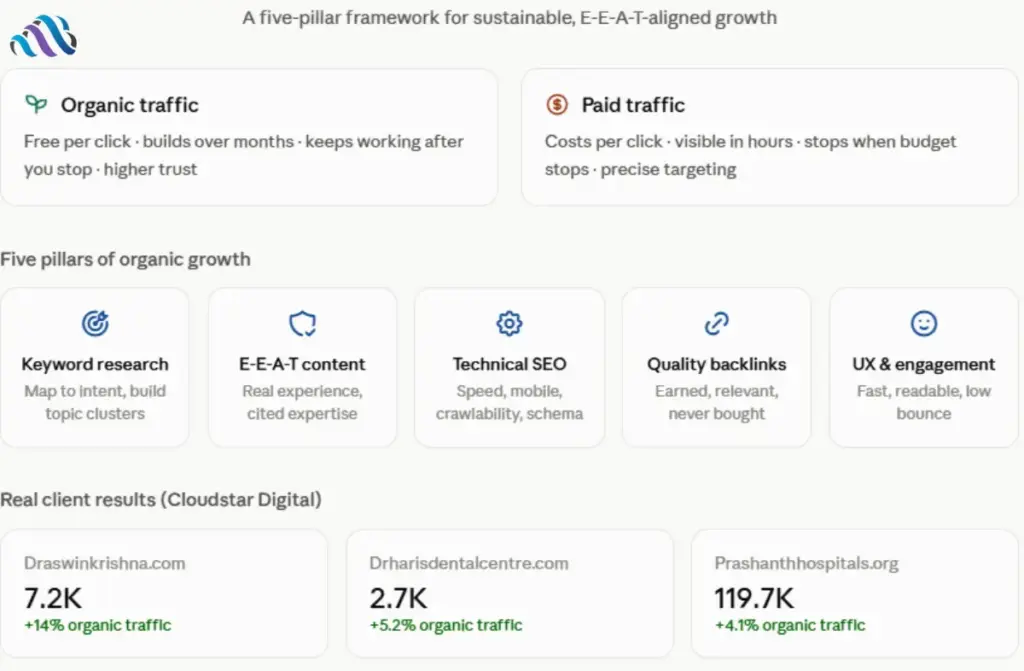
Rather than tell you this works, here’s what it looks like on three brands we currently manage SEO for, pulled straight from Semrush’s Domain Overview:
Draswinkrishna.com — Organic traffic up 14% year-over-year, with a 38% traffic share and 195 referring domains built through steady on-page and link-building work.
Drharisdentalcentre.com — A dental clinic site that grew organic traffic 5.2%, organic keywords +2%, and now pulls AI Overview citations across 25 pages — a sign that E-E-A-T-focused content is increasingly being surfaced in AI-driven search, not just traditional blue links.
Prashanthhospitals.org — Our largest healthcare account, now driving 119.7K monthly organic visits (+4.1%), ranking for 6,500+ organic keywords, and earning citations across ChatGPT, Google AI Overviews, AI Mode, and Gemini — 243 cited pages in total. This is a strong example of how consistent technical SEO, content depth, and backlink authority (502 referring domains) compound over time into both classic organic visibility and AI search visibility.
These aren’t outliers — they reflect the same five-step framework above, applied consistently over months, not days.
Final Thoughts
Sustainable organic growth comes down to five things done consistently: solid keyword research, genuinely useful content that reflects real expertise, a technically healthy site, backlinks earned through real value, and an experience visitors actually enjoy. None of it is a shortcut, but all of it compounds.
If you’re working on growing organic traffic for your own brand and want a second set of eyes on your current setup, Cloudstar Digital offers a full SEO audit and a personalized growth roadmap — feel free to reach out.


